
What’s Next
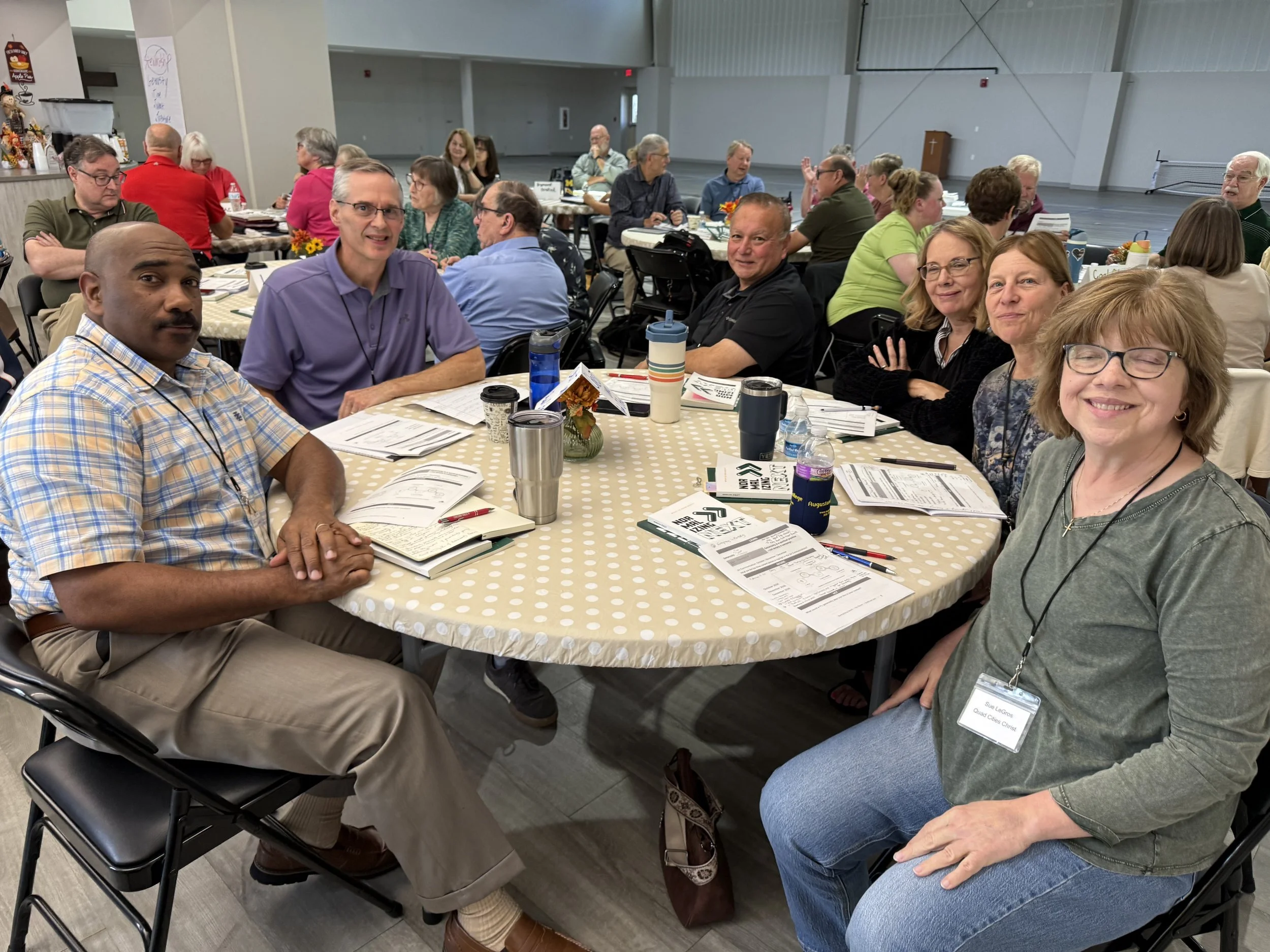
The team from Christ UMC in the photo above includes Dawn Cook, Paul Garcia, Sue LaGros, Dave Ramp and Kathy Ramp (not pictured: Melissa Chapman, Alice Haben and Mary Land.)
As part of the Normalizing Next Cohort of churches and teams from around the Illinois Great Rivers Conference, the TNT (Two-N-Team—Normalizing Next Team) traveled to Tremont, Illinois to participate in the first of a series of workshops hosted by Mike Crawford and led by Olu Brown and Mike Watkins. Mike Crawford is the District Superintendent for the North District and he is a former pastor at Christ UMC.
The first round of discussions included introductions of the participants and highlights of the participating churches. Interestingly, several of the churches highlighted their food pantries and described them as “the best food pantry in the conference.” (Dave Ramp did not become too boastful at that time. He could have easily bragged that Christ UMC has two food pantries that average 5 days of service every week.) It was encouraging and revealing to realize the importance of food pantries in communities throughout various regions of the state. Food insecurity is a systemic issue around the state, throughout our nation and in too many parts of the world.
The opening discussion also included an assessment of the current state of the church and the envisioned state of the church. Using a bell curve included in the book, “The UnStuck Church: Equipping Churches to Experience Sustained Growth” by Tony Morgan, churches were described along a continuum beginning with (1) Launch; (2) Momentum Growth; (3) Sustained Growth; (4) Sustained Health; (5) Maintenance; (6) Preservation; and (7) Life Support with Sustained Health at the top of the curve and Launch and Life Support on the side-edges of the curve. Many of the participants from the various churches described the current states of their congregations as being on the right-side of the curve identified as Maintenance, Preservation and Life Support. Most participants envisioned or desired that their congregations would be on the left side of the curve or at the top of the curve.
Perhaps, most interesting were some of the characteristics of congregations in these various stages of development. In the Launch stage, congregations were characterized as prioritizing reaching new people and a heavy reliance on volunteers. In the Momentum Growth stage, there is an outward focus and innovation & creativity are expected. In the Strategic Growth stage, there is a shift from personalities to teams and a discipleship path is established. In the Sustained Health stage, the church is unified and the ministry is multiplying. In the Maintenance stage, the church becomes insider-focused and silos begin to to go back to the way things used to be. In the Life Support stage, the church is unwilling to change and the church is aging.
These stages not only described congregations, they also described the individuals participating in the cohort. The morning began with an early morning launch—we left the church at 7:00am. Some of the participants admitted that they were not “morning people,” but we enjoyed the conversation and camaraderie as we rode together and learned more about each other. Everyone on the team from Christ UMC is retired (with the exception of the pastor). Some of the other churches included retirees as well as the lead pastor, the associate pastor and members of the church staff. The staff represented the younger participants on the cohorts.
It was eye-opening to learn about some of the challenges that are facing other congregations such as establishing a new identity following the discussions around disaffiliations and the impact of COVID. We also toured the Tremont UMC. The congregation built a new church and a family life center. The new church building includes extensive classrooms, meeting spaces and storage areas beneath the sanctuary. The churches debt was generously retired by a $350,000 gift from a member of the congregation. This level of generosity allows the church to focus squarely on missions, growth, ministry and outreach.
Olu Brown and Mike Watkins talked extensively about communicating the vision clearly to the congregation. They also explained the need to communicate frequently and to use language that would be easily understood by those who were new to the church. For example, they demonstrated how the word stewardship is often confusing, but the word generosity is fairly well-understood. Similarly, tithing is not only confusing, it can also be intimidating and an impossible step for most families to take. Rather than requesting that people tithe, they suggested asking people to begin by giving 1%. For those who can give more, welcome their generosity. However, every gift, regardless of the size or the amount is not only celebrated, it is connected to the mission and vision of the church. Each contributor needs to know what was accomplished as a result of their generosity.
Olu and Mike also emphasized that the communication should be personalized to every contributor, regardless of how many contributors may live at the same address. Their example was quite compelling—if both parents and their teenaged children contribute to the church, each person should receive a letter from the church in its own envelope. This example teaches and encourages generosity even among the youngest contributors. Rev. Dr. Martin Luther King, Jr. often said ‘everyone has the capacity to give.’ Jesus’ parable of the widow’s mite (that is a small amount of money given often compared in value to pennies) demonstrates the significance of the desire to give and the willingness to give sacrificial without regard to how the amount might compare to what someone else has given.
Olu talked about the power that we are given by God. The Greek word for power is dunamis. From this word, we derive the English word dynamite. The explosive capacity that we possess and that the church helps to direct in transformative ways relates to the three-sentence vision statement of Christ UMC. Each sentence conveys key concepts such as our identity as Christ-centered, multi-generational, reaching out, equipping, honoring tradition & embracing innovation, and lastly, striving to be a place where everyone belongs, serves and thrives.
What parts of the vision statement are most memorable for you? Which words are easiest for you to embrace, and which word is most troubling for you? What is the most appealing new ministry, thing or idea at the church? Who is someone new whom you’ve met at the church? Be sure to welcome them and invite them to explore the many opportunities to belong, grow, serve and thrive at Christ UMC.
We’ll look forward to seeing you and them in worship, in class, and on the mission field.
In Christ,
Jon McCoy
